
Enterprise video collection is not a crowdsourcing problem
The default assumption for many AI teams encountering video data for the first time is that it scales like text annotation - post a task to a crowd platform, review the output, iterate. That assumption breaks the moment the data involves specialized hardware, coordinated scenarios, multi-sensor sync, or safety-critical consent requirements.
Enterprise video data collection for robotics and embodied AI requires managed programs. A managed program means a vendor designs the capture protocol, owns the hardware setup, recruits and trains participants for your specific task set, runs QA at every stage, and delivers a dataset your model can actually train on. It is not a marketplace transaction. It is a production operation.
Understanding the distinction matters before you start evaluating vendors. Crowd platforms optimize for throughput at low cost. Managed programs optimize for data quality and distribution coverage at higher cost per hour. The economics look different, but so do the failure modes - and for robot training data, a poorly distributed dataset is far more expensive to discover after training than to prevent during collection.
The five infrastructure requirements for production-grade programs
Enterprise video data collection programs that reach production scale share five infrastructure characteristics. Teams that select vendors before verifying all five consistently report re-work, delivery delays, and data quality failures that cost more than the collection program itself.
- Capture hardware expertise - the vendor operates the rigs, not just contracts them out
- Participant recruitment and training infrastructure - curated pools, not open crowdsourcing
- Sensor synchronization and metadata integrity for multi-modal programs
- Multi-stage QA by domain-trained reviewers before any data leaves the vendor
- Consent, privacy, and data rights management that survives legal review in your jurisdiction
Capture hardware and scenario design
The quality of a video dataset is largely determined at the capture design stage. Poorly designed scenarios produce data that looks clean in isolation but fails to cover the distribution your model needs. Scene diversity, lighting variation, object configuration, environmental context, and task sequencing all need to be specified before a single recording session runs.
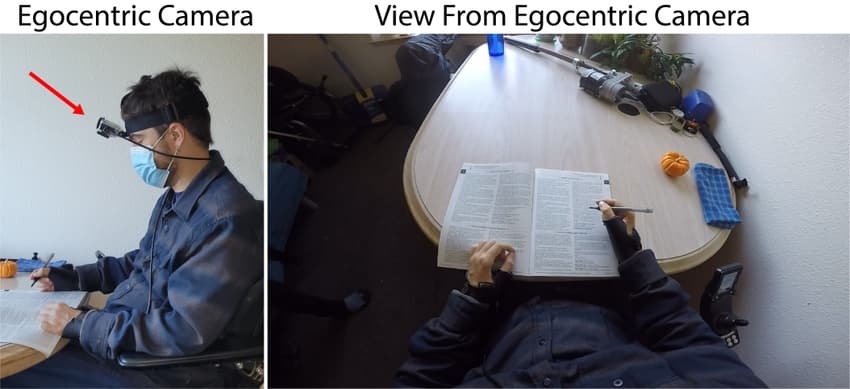
For egocentric and first-person programs - the primary format for robot manipulation and embodied AI training data - the hardware configuration matters enormously. Head-mounted rigs, wearable cameras, GoPro setups, and enterprise smart glasses all produce meaningfully different footage in terms of stabilization, field of view, resolution, and synchronization with auxiliary sensors. A vendor who has only run GoPro programs cannot simply substitute for a smart glasses program without redesigning the entire capture pipeline.
The right enterprise vendor treats scenario design as a deliverable, not a pre-sale exercise. Expect a written capture protocol document - covering hardware configuration, scenario scripts, environmental specifications, participant instructions, and failure-mode handling - before any recording begins.
Participant recruitment and session management
For robot training data, participant selection directly affects model generalization. A manipulation dataset collected entirely by one demographic of participants, in one type of environment, with one set of objects will produce a model that fails on the other cases. Task diversity, physical diversity, and environmental diversity all need to be engineered into the program at the recruitment stage.
Crowd platforms cannot reliably deliver this. Curated participant pools, matched to your domain requirements and diversity specifications, are a managed program capability. This includes training participants on the specific task set, verifying that they understand the scenario instructions, and running calibration sessions before production recording begins.
For programs with specialized requirements - surgical robotics, industrial manipulation, high-dexterity tasks - the vendor needs domain-matched participants: medical professionals, trained technicians, or workers with relevant manual skills. This is not something a general crowd platform sources reliably.
Multi-sensor fusion and data integrity
Humanoid robot and embodied AI training programs increasingly require multi-sensor datasets - RGB video synchronized with depth (RealSense, Azure Kinect, Orbbec), IMU, proprioceptive data, and force/torque sensor readings. The synchronization requirement is hardware-level, not software-level: if sensor timestamps are not locked in hardware, the resulting dataset contains sync drift that corrupts the learned action representations.
Ask any vendor you evaluate: what is your hardware-level sync architecture for multi-sensor programs? What is your measured sync error across sensor modalities? How do you validate sensor integrity after each recording session? Vendors who cannot answer these questions in technical detail are not ready to run multi-sensor programs.
Delivery format matters equally. Your training pipeline expects specific formats - HDF5, ROS2 bag, LeRobot format, or a custom schema. A vendor who delivers raw video files with a separate metadata spreadsheet is not delivering production-ready data; they are delivering material that requires significant engineering work on your end before training can begin.
QA standards that enterprise programs require
The QA infrastructure of a video data collection vendor is the single most important differentiator between programs that deliver training-ready data and programs that deliver data that looks complete but fails in training.
Automated QA catches obvious failures: corrupted files, missing metadata, out-of-spec resolution. It does not catch temporal inconsistencies in action sequences, incomplete task demonstrations, participants who did not follow scenario instructions, or sensor sync drift that falls within a technically valid range. Human review by domain-trained engineers is required for all of these.
When evaluating vendors, ask for a specific description of their human QA workflow - what a reviewer checks for in a first-person manipulation video, how long a typical review takes per hour of footage, what proportion of sessions get flagged and re-shot, and what happens to footage that fails QA. The answers distinguish genuine QA programs from checkbox processes.
- Human review by robotics-trained engineers - not generic labelers or automated-only pipelines
- Temporal consistency checks on action sequences and task completion
- Sensor data integrity validation at the recording level, not just file level
- Scenario compliance verification - did participants follow the task instructions?
- Re-shoot protocol with no additional cost when footage fails QA
- Documented error rates and QA metrics available on request
Consent, data rights, and compliance for international programs
Video data collection programs that operate across multiple countries face layered compliance requirements. GDPR applies when EU data subjects are recorded, regardless of where the processing vendor is based. PDPA (Thailand), PDPA (Singapore), and equivalent frameworks apply in APAC markets. US state biometric privacy laws apply when programs collect biometric identifiers - which first-person video increasingly does as gaze tracking becomes part of the sensor package.
Consent management cannot be an afterthought. Every participant must provide informed, documented consent for the specific use case their footage will be used for. Consent that covers "AI training" but does not specify robotics, or that does not include the right for the data buyer to use the footage for commercial model deployment, creates legal risk that surfaces at the worst possible time - typically when the model is ready to deploy.
Ask any vendor for a copy of their standard consent form and have your legal team review it before signing a program contract. Also confirm data residency: where is the footage stored, and does that location comply with your organization internal data governance policies?
The vendor checklist for enterprise evaluation
Use this checklist when running a formal vendor evaluation for an enterprise video data collection program. The items are not comprehensive - add your organization-specific requirements for compliance, technical stack, and SLAs - but they cover the criteria that most commonly determine program success or failure.
- Hardware: does the vendor operate the rigs themselves, or contract them to local partners?
- Sensor sync: what is the measured sync error for multi-sensor programs?
- Participants: curated pool or open crowd? Domain-matched recruitment available?
- Scenario design: is a written capture protocol provided before recording begins?
- QA: human review by domain-trained engineers, documented error rates, re-shoot policy?
- Delivery: what formats are supported - HDF5, ROS2 bag, LeRobot, custom schemas?
- Consent: GDPR, PDPA, biometric law compliance - share the consent form for legal review
- Data residency: where is footage stored, and does it meet your governance requirements?
- Pilot: will the vendor run a paid 50-100 hour pilot before the production contract?
- References: can they provide contact details for two previous customers in robotics or embodied AI?
DataX Power operates managed video data collection programs for enterprise AI teams building robot and embodied AI training datasets. Contact us to discuss your program requirements.
Learn about DataX Power video data collectionTiming your procurement for 2026 programs
The lead time between signing a vendor contract and first data delivery for a well-run managed program is typically four to six weeks - two weeks for capture protocol design and participant recruitment, and two to four weeks for initial recording sessions and QA cycles. Programs that try to compress this timeline consistently produce lower-quality data.
For teams planning production-scale programs in the second half of 2026, procurement conversations should start now. Managed vendors with genuine robotics domain expertise have limited program capacity, and the APAC market in particular has seen significant increase in enterprise demand for humanoid and embodied AI training data programs.
For programs targeting APAC deployment, Vietnam-based managed video data collection vendors are the primary option for combining production-scale capacity with APAC-local environments. Programs that require Vietnamese urban environments, APAC pedestrian-context footage, or manufacturing facility access in the region can be structured from a Hanoi base without the multi-country logistics overhead of running across several APAC markets. Procurement conversations for Vietnam-based video data collection programs are best started before internal timelines are committed - program slots at capable Vietnam vendors are limited and fill on a rolling basis.