Why the collection model decision comes before the vendor decision
Most robotics and computer vision teams scoping a new dataset go straight to a vendor shortlist. The more consequential choice comes earlier: whether the footage should come from crowdsourced video data collection, where distributed participants record wherever they live and work, or from studio collection, where participants perform scripted tasks on a controlled set with calibrated hardware. The two models produce datasets with different statistical properties, and no amount of downstream annotation changes that.
A policy trained on 2,000 hours from one well-lit studio kitchen learns that kitchen. A model trained on 2,000 hours from 800 homes learns what kitchens have in common, but it also absorbs shaky footage and inconsistent framing, along with the quirks of whatever camera each participant happened to own. Neither result is wrong; which one you want depends on the job.
There is also a third option, the hybrid program, which pairs a studio core with a crowdsourced channel for breadth. Which of the three fits depends more on what the model has to generalize across than on price.
Crowdsourced video data collection vs studio collection: what each model means in practice
Vendor proposals use these labels loosely, so pin them down before comparing prices.
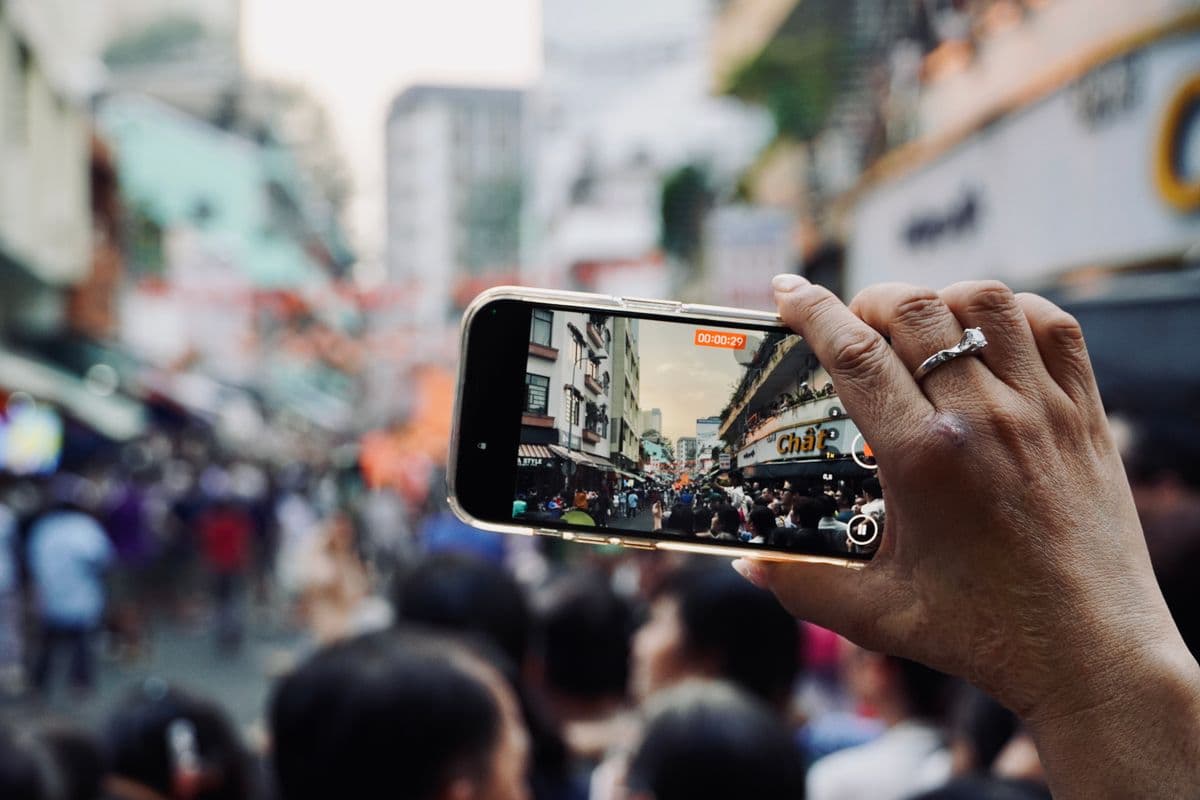
Crowdsourced data collection distributes capture to a large pool of participants who record in their own environments, following a written protocol. The research community has relied on this model for years. The Charades dataset, published as "Hollywood in Homes", crowdsourced the whole process, from script writing through recording to annotation, and ended up with 9,848 videos of 267 people across three continents. The Something-Something dataset had crowd workers act out more than 100,000 short clips against 174 caption templates such as "putting something on top of something". Ego4D, run by a multi-institution consortium, gathered 3,670 hours of daily-life video from 931 camera wearers in 74 locations across 9 countries.
In a commercial program, crowdsourced does not have to mean an open marketplace where anyone uploads anything. The managed version recruits and screens participants and trains them on the protocol. It either ships a standard capture kit or qualifies each participant's own device against a spec, and it reviews every upload before the footage counts toward delivery. Since proposals use the same word for both, ask which one you are being quoted.
Studio data collection, often called onsite video data collection, brings participants to a controlled location: a dedicated capture room, a mock kitchen or retail aisle, a warehouse bay, or a parked vehicle for in-cabin work. The vendor owns the cameras and lighting and controls calibration and scene layout. An operator supervises each session. EPIC-KITCHENS-100 sits between the two models. It used head-mounted cameras and unscripted activity in 45 real kitchens, giving 100 hours of footage with far more environmental variety than any single set could provide.
How crowdsourced, studio and hybrid collection compare
The table rates each model on nine criteria that matter to a training program. Every column assumes a managed program, with screened participants and a written capture protocol backed by human QA. An unmanaged crowd platform would score worse than the crowdsourced column on most rows.
Two rows matter most. Cost per usable hour gets its own section below, because headline per-hour quotes mislead. Best-fit training goal is the row most teams skip, and it should drive the decision more than cost.
Crowdsourced vs studio vs hybrid video data collection across nine program criteria
| Criterion | Crowdsourced | Studio / onsite | Hybrid |
|---|---|---|---|
| Scene diversity | Hundreds of real homes, shops and streets | One or a few sets; variety has to be built in | Real-world breadth plus controlled anchor scenes |
| Participant diversity | Broad reach across cities, ages and body types when quotas are enforced | Limited to people who can travel to the site | Quota-driven across both channels |
| Hardware and calibration control | Varies unless kits are shipped and verified | Full control: fixed rigs, per-session calibration | Full on studio hours, spec-checked on field hours |
| Session-to-session consistency | Framing, lighting and pacing vary by participant | High and repeatable | High in the anchor set, variable in the field |
| Cost per usable hour | Lower capture cost, offset by higher rejection and review | Higher capture cost, low rejection | Blended; depends on the split |
| Throughput | Scales with the participant pool, many sessions in parallel | Capped by rooms, rigs and trained operators | Parallel field capture, studio reserved for hard tasks |
| QA burden | Heavy: every upload reviewed, rejections re-queued | Light to moderate: most issues caught live | Two QA tracks to run and reconcile |
| Consent and privacy | Bystanders, homes and screens in frame; remote consent checks needed | Consent at check-in, no bystanders, controlled frame | Two consent flows under one data-protection plan |
| Best-fit training goal | Egocentric activity diversity, daily-life tasks, generalization | Precise manipulation demos, multi-sensor sync, in-cabin monitoring | Large programs that need breadth and precision together |
1. Crowdsourced collection - breadth at the cost of control
Crowdsourced collection is the better choice when the model has to cope with ordinary, uncontrolled environments. That covers egocentric activity recognition and household task understanding, hand-object interaction across varied objects, and pre-training for embodied foundation models. All of them benefit from footage shot in real homes, where the clutter is real and no two layouts or lighting setups match. Distributed capture also reaches people a studio rarely sees: older participants who will not cross a city for a session, parents who can only record at home, workers in regional towns.
Throughput is the other advantage. A studio with four capture rooms runs four sessions at a time. A crowdsourced program with 300 active participants can produce hundreds of hours a week once onboarding is complete, and adding a new city is a recruitment exercise rather than a build-out.
The failure modes are predictable, and a vendor should be able to explain how it controls each one before the pilot starts:
- Device heterogeneity
- -Different phones and cameras bring different lenses, fields of view, frame rates, rolling-shutter behaviour and compression, which becomes a domain shift the model can latch onto
- -Mitigation: ship a standard kit (same head-mounted camera or smart glasses, same firmware and locked settings), or qualify participant devices against a written spec and log the device model on every clip
- Rejected footage
- -Hands out of frame, occluded views, the wrong task, missing segments, poor light and privacy violations all force rejection
- -As a planning range, first batches from newly onboarded participants can lose 20-40% of footage, falling as participants are coached; budget for it rather than hoping it will not happen
- Protocol drift
- -Participants simplify tasks over time, skip setup steps, speed up, or settle into one room and one routine
- -Mitigation: per-participant hour caps, rolling spot checks against the protocol, task rotation, and short re-briefs as soon as drift shows up in QA metrics
- Self-selection bias
- -Open sign-ups skew toward younger, urban, tech-comfortable participants
- -Mitigation: set quota targets before recruitment opens and choose channels that fill the hard-to-reach cells
- Privacy exposure
- -Homes contain family members, documents, screens and street addresses
- -Mitigation: bystander rules, recording-zone briefings, and a redaction pass before anything is delivered
2. Studio collection - control at the cost of variety
Studio or onsite video data collection is the right default when the data has to be precise. Manipulation demonstrations for imitation learning are the obvious case, along with grasp datasets shot from wrist and overhead cameras and multi-view capture for 3D pose. Anything synchronized with force/torque or IMU streams belongs here too. All of it needs fixed rigs with known camera positions and calibration checked every session, which is hard to guarantee in a participant's living room.
Studios also make consent and privacy simpler. Nobody walks into frame unannounced and there are no personal documents on the counter. Consent is taken in person at check-in. That control often decides it for surgical and medical robotics or in-cabin driver monitoring, and for any program that records sensitive attributes.
The failure modes run in the opposite direction:
- Environment homogeneity
- -One room, one lighting setup, one countertop height and one object set produce a model that performs well on that set and degrades elsewhere
- -Mitigation: scheduled set rotations, randomized object sets, lighting variation and multiple layouts written into the protocol from day one
- Overfitting to one set
- -Background features, wall colours and fixed camera angles become shortcuts the model relies on instead of the task
- -Mitigation: hold out an entire set or layout for evaluation so the team measures transfer before deployment rather than after it
- Narrow participant pool
- -Studios tend to reuse the same 20-50 reliable participants, so a handful of people dominate the hours
- -Mitigation: per-participant hour caps and recruitment targets by age, height, handedness and skin tone
- Throughput ceiling
- -Output is capped by the number of rooms, rigs and trained operators
- -Mitigation: plan capacity against the delivery schedule at contract stage
3. Hybrid programs - a controlled anchor with distributed breadth
Many production programs end up combining the two. The studio produces a core of high-precision data on the exact hardware configuration the deployment robot will use; the crowdsourced channel adds the environmental and participant variety the studio cannot supply. The split follows the goal. A humanoid program pre-training on everyday human activity might route most of its hours through distributed egocentric capture and keep a smaller share for studio manipulation demos. A bin-picking program would likely invert that ratio.
DROID is a good reference point from robotics research. Its 50 data collectors at 13 institutions spent 12 months gathering 76,000 demonstration trajectories (roughly 350 hours) across 564 scenes and 86 tasks. The design choice that made it work was an identical hardware setup at every site. Distributed collection adds diversity without adding noise only when the capture spec travels with it.
In a hybrid program, both channels have to share the same capture protocol and task taxonomy. They also need a single metadata schema, so every clip records device, environment and participant attributes, and a single QA rubric, so a clip accepted in the field would also pass in the studio. Without those, you end up with two datasets that happen to share a storage bucket.
Cost per usable hour matters more than cost per captured hour
Quotes are usually expressed per captured hour, which flatters crowdsourced collection. The number that matters is cost per usable hour: what you pay for footage that passes QA and meets the protocol, including the review effort needed to find out.
Take an egocentric program priced within the ranges in our video data collection cost guide. Crowdsourced capture at $80 per captured hour with 30% of footage rejected works out to about $114 per usable hour before review labour. Studio capture at $150 per captured hour with 8% rejected works out to about $163. Review time is heavier on the crowdsourced side because every upload needs checking, so the real gap is narrower than the headline rates suggest. Treat these as planning figures, not quotes; actual numbers move with hardware and participant profile, and with how deep the QA goes.
The arithmetic also ignores value. If studio data does not generalize beyond the set, or crowdsourced footage cannot be synchronized with robot state, the price per hour is irrelevant. Cost is a reasonable tiebreaker between two models that both fit the goal, and a poor way to choose the goal in the first place.
- Ask for the expected rejection rate in the pilot, and who pays for rejected hours
- Ask whether QA review is priced separately or included in the per-hour rate
- Ask how kit shipping, device loss and replacement are handled in crowdsourced programs
- Ask how set changes and rotations are priced in studio programs
How to choose: questions to settle before the RFP
Work through these in order. The first two usually decide the model; the rest shape the contract and the pilot design.
- What does the model need to generalize across? If the answer is environments, people and everyday objects, start crowdsourced. If it is precise trajectories on one robot, start in the studio.
- Does the footage need to be synchronized with other streams? Robot joint state, force/torque, multi-camera calibration and depth all push toward a studio or a hybrid with a studio core.
- How sensitive is the content? Medical settings, minors, in-cabin identity data and strict consent regimes favour controlled capture.
- What is the delivery timeline? Several thousand hours in a quarter usually needs distributed capacity.
- How will you evaluate transfer? Decide the held-out environments and participants before collection starts, whichever model you choose.
DataX Power runs onsite/studio and crowdsourced video data collection, including hybrid programs, across egocentric, third-person, robot manipulation and mobile navigation capture. Participant networks cover Vietnam, Thailand, Singapore and Malaysia, and programs scale from 100-hour pilots to 50,000-hour production on the same contract.
Scope your collection modelFrequently asked questions about crowdsourced and studio collection
Run the pilot the way production will run. A crowdsourced pilot with ten hand-picked participants says little about a 400-participant program, and a single-set studio pilot says nothing about set rotation. These questions come up most often at that stage.
- Is crowdsourced video data collection good enough for robot training?
- For some goals, yes. Crowdsourced egocentric footage suits pre-training perception and activity models on diverse real-world scenes, and large research datasets such as Ego4D and Charades were built on distributed capture. It is a poor fit for precise manipulation demonstrations that must be synchronized with robot state or force data. Many robotics programs use crowdsourced footage for breadth and studio capture for demonstrations.
- What rejection rate should I expect from crowdsourced video collection?
- As a planning range, first batches from newly onboarded participants can see 20-40% of footage rejected for framing, occlusion, wrong tasks or privacy issues, and the rate falls as participants are coached. Studio sessions usually see much lower rejection because operators catch problems live. Ask any vendor for the pilot rejection rate and who pays for rejected hours.
- How do you control device differences in crowdsourced collection?
- The most reliable method is to ship every participant the same capture kit with locked settings and firmware. Where participants use their own devices, each device should be qualified against a written spec for resolution, frame rate and field of view, and the device model should be logged in every clip's metadata so the training team can measure and correct for device effects.
- Is studio data collection more privacy-safe than crowdsourced collection?
- Generally, yes. A studio controls who is in frame and keeps personal spaces out of the footage, and consent is taken in person. Crowdsourced capture in homes can pick up family members, documents or screens. That means bystander rules and remote consent verification, plus a redaction pass before delivery. Both models can run under GDPR and the PDPA regimes in Singapore, Malaysia and Thailand, but the studio model has fewer points of failure.
- Can one vendor run studio and crowdsourced collection on the same program?
- Yes, and it simplifies hybrid programs because one capture protocol and QA rubric can govern both channels, along with a shared metadata schema. Footage from the field and the studio is then comparable at delivery. DataX Power runs onsite/studio and crowdsourced collection within one program, with participant networks in Vietnam, Thailand, Singapore and Malaysia.