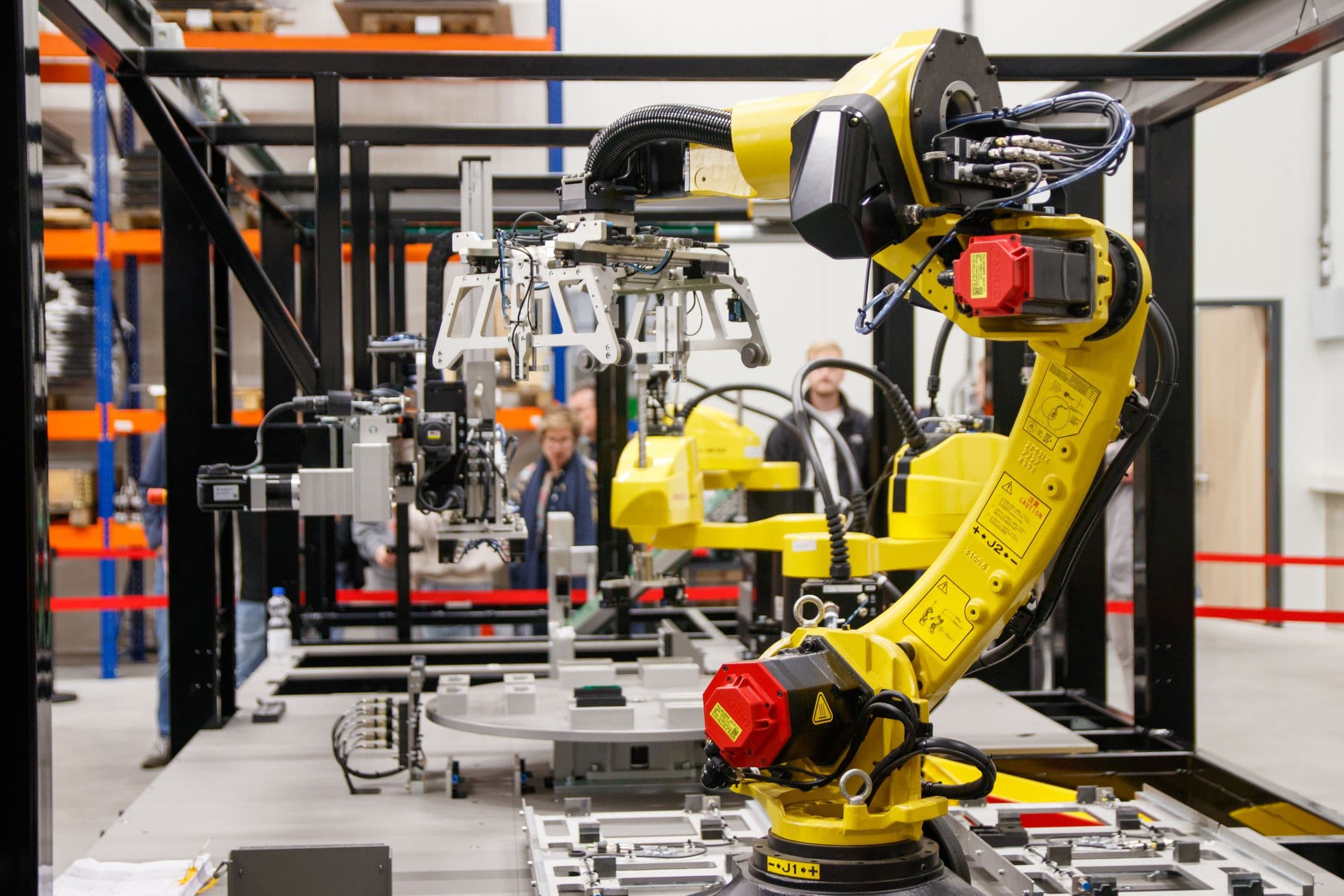
What contact force data is and why simulation cannot replace it
Contact force data is sensor data captured during physical robot-object interaction that records the forces and torques acting at or near the contact interface. It is distinct from joint torque data (which reflects motor commands and link inertia) in that it directly measures the mechanical effect of contact on the robot end-effector or tool.
The most common form is six-axis force-torque (F/T) sensor data: three force components (Fx, Fy, Fz) and three torque components (Tx, Ty, Tz) measured at a sensor mounted between the robot wrist and the end-effector. Tactile sensors provide a spatially-resolved variant: arrays of pressure-sensitive elements mounted on fingertips or palm surfaces that map the contact force distribution across the contact area.
The sim-to-real gap is sharpest for contact dynamics. Physics simulators model rigid-body contact reasonably well, but real-world contact involves surface compliance, deformation, friction variation across surface textures, and micro-slip events that current simulators do not accurately replicate. A policy trained entirely on simulated F/T data will expect contact transitions to follow the simulator's idealized dynamics, and will behave incorrectly when real contact deviates from this expectation.
Physical AI programs that omit F/T data collection consistently produce one of two failure modes at deployment: over-grip (the robot applies excessive force to accommodate uncertainty about contact, crushing or deforming objects) or under-grip (the robot fails to detect that contact has not been achieved and proceeds through subsequent task steps without a secure grasp). Both failure modes are data problems, not model problems.
Task categories where F/T data is non-negotiable
Not all robot tasks require dedicated F/T data. Simple grasping and transport of rigid objects with stable surfaces can often be learned from visual and kinematic data alone. F/T data becomes essential when the task involves contact dynamics that cannot be inferred from visual information.
1. Precision insertion tasks
Connector insertion, peg-in-hole assembly, screw threading, and snap-fit engagement all require the robot to apply controlled force in a specific direction while maintaining tolerance on lateral position. The force profile during a successful insertion follows a characteristic pattern: initial contact, resistance buildup as the peg enters the hole, a click or drop when the snap engages.
Policies trained without F/T data on insertion tasks learn to reproduce the motion trajectory of successful demonstrations but have no representation of the force state that indicates insertion success or misalignment. They cannot distinguish between "connector fully seated" and "connector pressed against the outer rim of the socket" from visual information alone.
F/T data for insertion tasks should capture the full force profile from approach through completion, at 1000Hz to resolve the contact transients. The training dataset should include demonstrations of both successful insertions and near-miss insertions followed by correction, so the policy learns both the target force profile and the corrective response to misalignment.
2. Compliant and soft object handling
Handling objects that deform under contact - food items, fabric, foam, biological tissue, or flexible electronics - requires the robot to regulate grasp force below the deformation threshold while maintaining sufficient grip to prevent slip. This is a force control problem: the robot must continuously sense and respond to the force at the contact interface.
Visual information is insufficient for compliant object handling because deformation is often not visible from the robot's camera viewpoint, and because the relationship between applied force and deformation varies across objects of the same class. A ripe tomato and an unripe tomato look similar but have very different compliance.
F/T data for compliant object handling should be collected at 500-1000Hz, with the training dataset covering the target object class across its full range of compliance variation. For food handling programs, this means collecting across ripeness stages; for fabric programs, across fabric weights and weave densities.
3. Surface following and polishing tasks
Grinding, sanding, polishing, and surface inspection tasks require the robot to maintain a target normal force against a surface while following a trajectory. The contact force is the primary control variable, and the robot must continuously adapt its motion to maintain force against surface curvature variation.
These tasks are among the most dependent on real-world F/T data because surface contact dynamics are highly environment-specific: material hardness, surface roughness, tool wear, and lubricant presence all affect the force profile that corresponds to correct tool engagement. Simulation can approximate smooth, rigid surfaces but cannot reproduce the tactile complexity of real machined or cast parts.
F/T data for surface following should be collected with the actual tooling (grinding wheel, sanding pad, or inspection probe) that will be used at deployment, on the actual workpiece material or a close surrogate. Cross-material generalization without corresponding training data is unreliable.
4. Bimanual load transfer and handoff tasks
Tasks where an object is transferred between two robot hands require force sensing to coordinate the handoff. During load transfer, the outgoing hand must reduce grip force as the incoming hand applies grip force, without both releasing simultaneously (which drops the object) or both gripping simultaneously (which stresses the object).
This coordination is learned from the F/T profile that characterizes a successful handoff: the force on the outgoing wrist drops as the force on the incoming wrist rises, with a brief period of shared load during the transition. Without F/T data on both wrists, the policy has no signal to learn this coordination - it can only observe the motion trajectories, which look similar for successful and failed handoffs until the object actually drops.
Bimanual handoff training datasets should include both successful handoffs and deliberately failed handoffs followed by recovery, with the F/T profiles annotated at the handoff transition point so the training pipeline can align demonstrations from different operators who perform the handoff at different speeds.
Sensor specifications for F/T data collection
The F/T sensor specification must match the task requirements. Under-specified sensors produce clipped or noisy data; over-specified sensors may lack sensitivity in the operating range relevant to the task.
For general manipulation tasks, a 6-axis F/T sensor with a force range of 100-500N and torque range of 10-50Nm covers most pick-and-place and assembly operations. For precision insertion tasks, lower-range sensors (25-100N, 2-10Nm) provide better resolution in the low-force regime where insertion alignment is sensed. For industrial force tasks (grinding, assembly of large components), higher-range sensors (1000N+) are required.
Sampling rate should be minimum 1000Hz for tasks with sharp contact transients (insertion, snap fitting). For slower force-control tasks (polishing, compliant handling), 250-500Hz is typically sufficient. Higher sampling rates produce larger datasets but also capture vibration and noise that may need filtering before training.
Tactile sensor arrays for fingertip-level contact sensing typically operate at 100-500Hz, with spatial resolution of 2-5mm between sensing elements. Arrays with higher element density (1-2mm pitch) provide better contact geometry discrimination for precision grasping but are more expensive and more susceptible to damage.
Integrating F/T data with visual and kinematic streams
F/T data is only useful as training signal when it is time-synchronized with the visual and kinematic data streams that provide the full observation at each timestep. A training example that pairs an F/T reading with a mismatched video frame or joint state vector provides incorrect supervision.
Hardware-level synchronization using a shared clock signal across all sensors is the most reliable approach. Software synchronization using timestamps introduces jitter from OS scheduling and communication latency, which at 1000Hz F/T sampling rates can produce effective misalignment of 5-15ms between modalities.
When hardware synchronization is not available, the data collection pipeline should record raw timestamps from each sensor clock and apply post-hoc alignment using calibration events - brief, distinct actions (a sharp tap on a hard surface, for example) that produce identifiable signatures in F/T, audio, and video simultaneously, allowing clock drift to be measured and corrected.
In the training pipeline, F/T data is typically normalized per-sensor to account for variation in sensor calibration across collection sessions and sensor units. Gravity compensation must be applied to remove the static force component from the robot's tool weight, so that the residual F/T signal reflects only contact forces. Programs that skip gravity compensation produce F/T data where the contact signal is dominated by tool weight, which is not informative for policy learning.
DataX Power's data collection infrastructure includes 6-axis F/T sensors, wrist-mounted tactile arrays, and a hardware-synchronized multi-modal recording pipeline. We support programs requiring force-annotated training data across manipulation, insertion, and compliant-object tasks.
Discuss force data collectionQA for contact force training data
F/T data quality issues are not visible in video review. QA requires automated signal analysis of the force streams to identify collection artifacts before the data enters the training pipeline.
Check for sensor clipping: events where the force reading saturates at the sensor maximum. Clipped events indicate that the collection task involved forces outside the sensor's measurement range, and the corresponding demonstrations should be flagged for review or excluded.
Check for drift: slow drift in the zero-force baseline over the course of a collection session indicates thermal expansion in the sensor or mounting hardware. If uncorrected, drift shifts the force readings in one direction over time, creating artificial trends in the training data that the model may learn as task-relevant signal.
Check for synchronization artifacts: if the F/T timestamps show irregular intervals (variance greater than 10% of the nominal sampling period), the sensor's data delivery is not meeting its specification and the data should not be used without investigation of the cause.
Human review should verify that the F/T profile of each demonstration matches the expected profile for that task. An insertion demonstration where the force never exceeds 2N should be flagged as a potential demonstration where the robot did not actually make contact. A polishing demonstration where the normal force varies by more than 50% of the target value throughout the task should be flagged as a demonstration of poor technique that may teach the policy incorrect force regulation.